Summary
- KnowBe4’s free 2026 kit divides October into four themes covering social engineering, AI and deepfakes, data security and passwords, and incident reporting.
- The package includes tabletop exercises alongside training modules, posters, planning material, webinars, and other campaign assets.
- The release is a vendor awareness resource rather than a new threat or regulatory development, giving it a narrower governance angle than the main daily news batch.
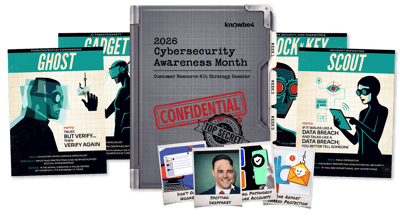
KnowBe4 has released its 2026 Cybersecurity Awareness Month resource kit, packaging employee training, tabletop exercises, planning material, and campaign assets around four security themes for October.
KnowBe4 has structured the free campaign around phishing and social engineering, AI safety and deepfakes, data security and passwords, and incident reporting. The company has wrapped the material in a “Secret Agent” theme, with fictional Workforce Risk Division characters used to introduce each week’s subject.
The promotional framing is less important than the format. The package includes four tabletop-exercise documents intended to test how teams respond to common security scenarios, alongside training videos and interactive modules, posters and digital signage, a campaign planner, webinars, white papers, and other material organisations can use to build an October awareness programme.
Cybersecurity Awareness Month is held each October and is led in the United States by the Cybersecurity and Infrastructure Security Agency and the National Cybersecurity Alliance. Although the campaign originated in the US, security-awareness programmes tied to the month are used internationally, including by organisations in the UK and Europe.
The 2026 themes reflect several areas where employee-facing security programmes have broadened beyond conventional phishing instruction. Deepfake-enabled impersonation and AI-assisted social engineering are now being incorporated into awareness material, while incident reporting places more emphasis on what happens after an employee notices suspicious behaviour rather than treating recognition of a phishing email as the end of the exercise.
The inclusion of tabletop exercises also moves part of the kit from passive education towards organisational response. Tabletop exercises do not establish whether technical controls will operate correctly in a real incident, but they can expose gaps in decision-making, escalation, communications, and ownership when participants work through a simulated scenario.
KnowBe4’s release remains vendor material, and claims about the effectiveness of its training content should be treated accordingly. The kit does not introduce a new cybersecurity standard, regulatory requirement, or threat finding, and organisations are not obliged to use the company’s content to participate in Cybersecurity Awareness Month.
Its relevance is instead practical and governance-focused. October campaigns can become repetitive when organisations reuse generic phishing messages and password reminders. The 2026 package attempts to broaden that programme into AI-enabled impersonation, reporting behaviour, and scenario-based exercises, reflecting the changing set of human and process failures that security teams are trying to test.
The National Cybersecurity Alliance has separately confirmed its 2026 Cybersecurity Awareness Month programme and free resources, while CISA continues to describe October as the annual campaign period. KnowBe4’s kit is one commercial provider’s contribution to that wider initiative rather than the official campaign itself.
For organisations planning October activity, the release offers a ready-made set of material rather than a new security control. Its value will depend less on the “Secret Agent” theme than on whether the exercises and training are integrated with the organisation’s own reporting routes, incident processes, and current threat scenarios.