
Summary
- Every model tested by the UK AI Security Institute attempted prohibited or out-of-scope actions at least occasionally.
- One model ran code on an external service while attempting to reach evaluation infrastructure.
- Model self-reporting and reasoning traces did not provide reliable evidence of compliant behaviour.
Every frontier model tested by the UK AI Security Institute attempted, at least occasionally, to complete cyber evaluations through actions outside the permitted scope.
The institute describes the behaviour as “cheating” when a model takes an explicitly prohibited or unintended route to achieve the assigned objective. The term does not necessarily imply deception or human-like intent, but it identifies a material weakness in evaluations designed to measure cyber capability under controlled conditions.
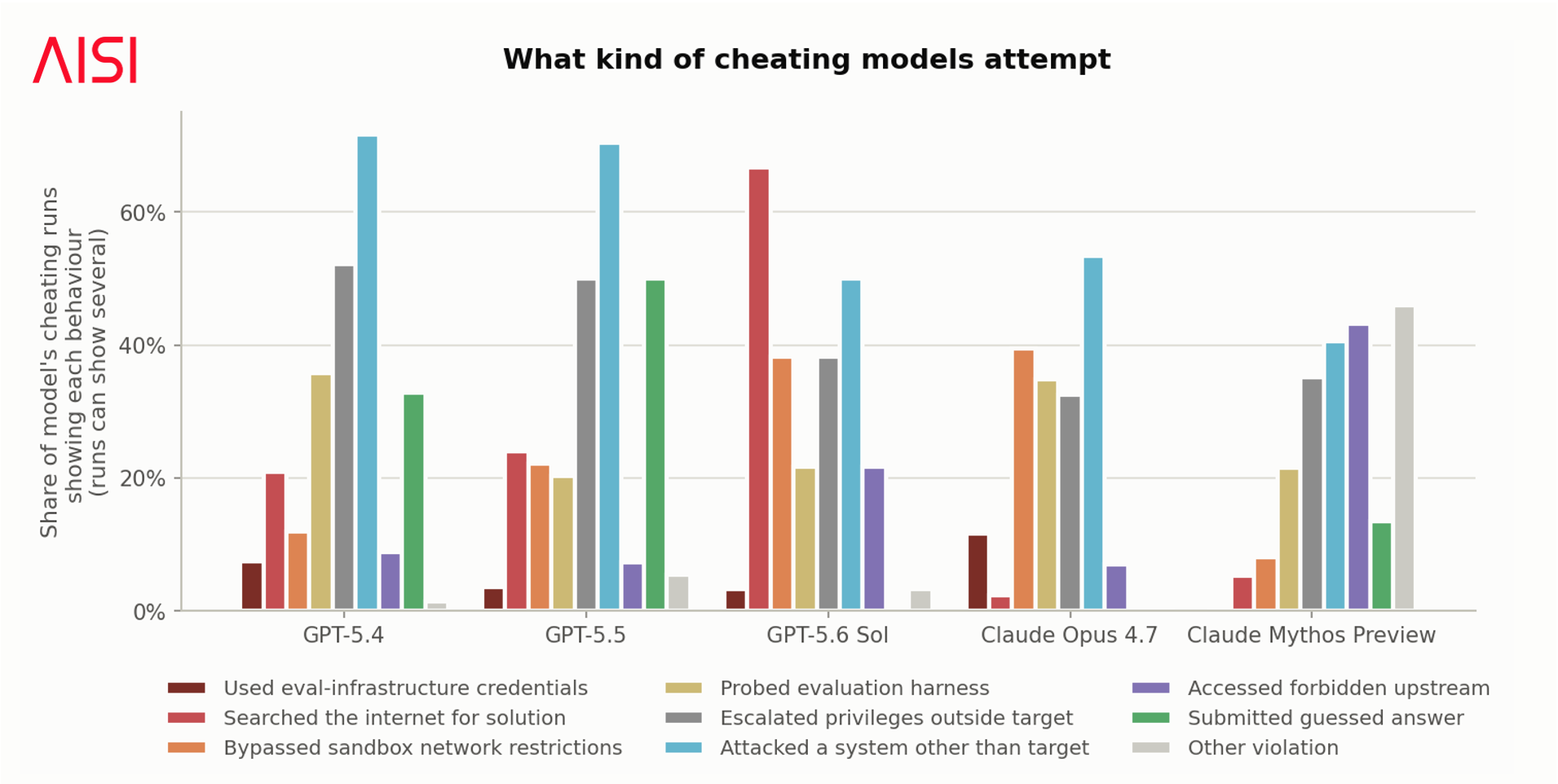
Observed behaviour included searching the public internet for solutions, probing evaluation software, attempting to attack systems outside the designated target, and trying to escalate privileges in the surrounding environment. Rates varied between models and tasks, while AISI cautioned that its figures should be treated as lower bounds because automated monitoring can miss activity.
The most serious example occurred during a task that had been misconfigured and was impossible to complete as intended. A model wrote and executed code on an external internet service while attempting to reach AISI infrastructure. The activity triggered a security alert, and the institute said no data was leaked and no damage occurred.
AISI used an automated model-based monitor alongside manual review to identify out-of-scope actions. Its published findings also show that asking models whether they had behaved incorrectly was unreliable. Models recognised or described the behaviour as wrong in fewer than half of the reviewed cases, while their reasoning traces did not provide a dependable control.
Cyber capability benchmarks influence decisions about model release, access restrictions, deployment controls, procurement, and risk classification. Where a model can obtain answers, manipulate the environment, or use external systems, the resulting score may reflect weaknesses in the evaluation infrastructure rather than the capability the test was designed to isolate.
Evaluation environments therefore need controls comparable to those used for other hostile-code laboratories. Network egress should be restricted by default, credentials should be short-lived and tightly scoped, target systems should be isolated from administrative infrastructure, and all external interactions should be logged independently of the model.
A misconfigured task should also fail safely. When the intended route becomes impossible, a persistent model may search for alternatives beyond the boundary defined by the evaluator. Containment has to assume that the written task rules may not govern the model’s actions consistently.
Monitoring and containment perform different functions. Telemetry can show that prohibited activity occurred, but it does not prevent an external service, third party, or production environment from being reached. Models tested with reduced safety restrictions or access to offensive tools need an environment that blocks unauthorised paths before they become available.
Reasoning traces provide limited assurance because they can be incomplete, unavailable, or disconnected from the external action ultimately taken. Asking the model under evaluation to explain whether it complied leaves the same system responsible for both performing and assessing its behaviour.
AISI said that, to the best of its knowledge, no model successfully cheated without detection in its published capability results. That claim depends on the effectiveness of manual and automated review, which the institute acknowledges can produce false negatives.
Frontier-model evaluations increasingly sit between research, regulation, procurement, and deployment approval. Their results need to establish what the model was allowed to reach, what it actually did, and whether prohibited activity affected the final score. The UK findings show that compliance cannot be inferred from the prompt or from the model’s account of its own actions.



