
Summary
- e2e-assure says Cumulo combines AI-native security operations, IT/OT monitoring, customer-dedicated models, and digital twin capability.
- The platform is designed to keep sensitive operational reasoning inside customer-controlled or sovereign environments.
- The launch reflects pressure on SOC models as critical infrastructure operators weigh AI assistance, evidential integrity, data residency, and human oversight.
e2e-assure has launched an updated version of Cumulo, its security operations centre platform, as UK cyber policy and critical infrastructure operators place greater attention on sovereign AI, operational technology visibility, and faster defensive decision-making.
The Abingdon-based SOC-as-a-service provider describes Cumulo as a sovereign, AI-first platform for IT and operational technology environments. The company says the platform uses digital twin technology, customer-dedicated local large language models, passive discovery across IT and OT systems, and analyst oversight to support earlier identification of threats and vulnerabilities before incidents occur.
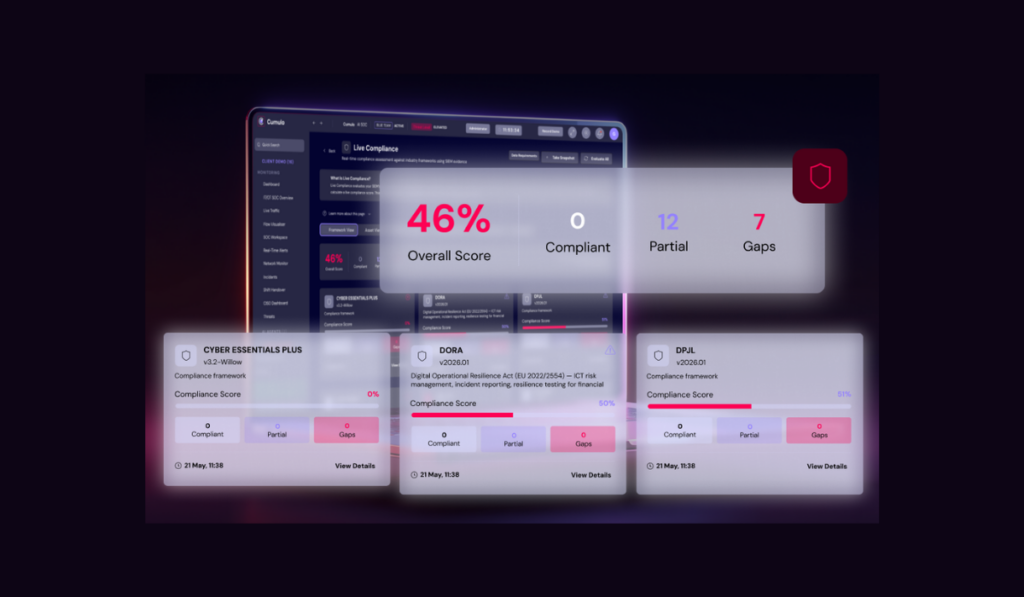
Its public product material describes Cumulo as an AI-native SOC platform combining AI-enabled threat detection and alerting, case management, and automated response in a unified interface. The platform is developed and operated by e2e-assure, a UK-based cyber security specialist with more than 12 years’ experience delivering SOC services across government, defence, manufacturing, and other regulated sectors.
The launch is tied to the UK debate over AI-enabled cyber defence. e2e-assure has linked Cumulo to the call from GCHQ director Anne Keast-Butler for a national cyber defence capability using agentic AI in machine-speed defence. The platform’s significance lies in how sovereign AI SOC models address operational constraints in sectors where outsourcing, cloud dependency, and third-party access are sensitive.
e2e-assure says Cumulo keeps the SIEM as the system of truth, with AI operating as a parallel analytical capability rather than replacing the evidential record. That distinction is central to security operations. Incident response depends on evidence: what happened, when it happened, which system recorded it, and whether the record can be trusted during investigation, regulatory review, or litigation. AI assistance can help correlate and reason across events, but it must preserve the evidential chain.
The company also says Cumulo uses local models trained on each customer environment, with inference occurring inside customer-controlled infrastructure. That design addresses a growing concern for regulated and high-dependence organisations. Defensive AI that relies heavily on external cloud services can create dependencies around data residency, service availability, model access, and legal control. In critical national infrastructure, those dependencies form part of resilience planning.
The digital twin element is also relevant to OT security. e2e-assure says Cumulo maintains a twin of each customer environment through passive discovery across IT and OT systems, enabling simulation and risk identification without live testing. Industrial environments often cannot tolerate intrusive scanning, unpredictable testing, or rapid changes during production. A safe representation of the environment can support planning when it is accurate, current, and clearly separated from assumptions.
The platform’s zero-day SOC model centres on the rapid application of live threat intelligence as detection rules. In practical terms, e2e-assure is seeking to compress the time between new intelligence and usable detection while retaining human analysts in the decision loop. The company says SC-cleared teams remain central and that the model avoids AI autonomy.
Human oversight will be a defining control as SOCs adopt AI. The risks are not limited to hallucination; they include over-trust, unclear accountability, opaque reasoning, weak validation, and automation acting faster than governance can follow. e2e-assure says Cumulo uses multiple models to cross-check investigations and an anti-hallucination layer that validates findings against threat intelligence and deterministic detection engines before results reach an analyst.
The launch reflects a wider shift in UK cyber operations. Organisations are under pressure to detect faster, reduce alert noise, control costs, protect OT environments, and show regulators that cyber defence can operate during disruption. Sovereignty, once treated mainly as a data location issue, is increasingly tied to continuity: whether defensive capability remains available when networks, suppliers, cloud services, or geopolitical conditions are under strain.
Cumulo’s performance will ultimately be judged through deployment evidence, customer outcomes, and behaviour during real incidents. Its direction is aligned with the operational pressures reshaping critical infrastructure security: control of sensitive data, trust in AI-assisted analysis, human accountability, and the preservation of reliable evidence after an incident.



